
Your customers are increasingly reluctant to commit outright to assets that may not deliver full ROI before the next technology cycle arrives. This is reshaping the questions buyers bring to your sales conversations – and the answers your competitors are starting to offer.
Equipment is still widely treated as an investment – but for many businesses, it has become a source of capital lock‑up. That is exactly what our European Business Equipment Outlook 2026 reveals. Based on insights from more than 1,000 decision‑makers across 11 European countries, the report shows that for most businesses, capital locked into physical equipment is now actively constraining business growth.
For manufacturers and their distribution partners, these findings matter. They explain why customer conversations are getting harder, why deals stall later in the cycle, and why the question of how equipment is acquired is increasingly shaping whether it gets acquired at all. What follows is a read of your customers’ world – and what it signals for how you go to market.
A context that makes things worse
To understand why capital lock‑up has become such a pressing issue, we first need to look at the environment businesses are operating in. According to our survey, 95% of respondents say their equipment becomes obsolete faster than it did five years ago. The impact is significant: 43% say their equipment sometimes becomes obsolete before delivering the expected return on investment.
In this context, committing to heavy upfront investment is increasingly risky. This is where capital lock‑up becomes a central challenge, as businesses continue to tie up capital in assets that lose value faster than anticipated.
What this signals for OEMs and equipment suppliers

When equipment ownership constrains business growth
The numbers speak for themselves: 87% of business leaders say that capital lock-up in equipment has, at some point, limited their company’s growth opportunities. Only 13% say they have never experienced this problem.
This is not a marginal phenomenon. It is the norm. And for 35% of respondents, this constraint occurs frequently or very frequently – not occasionally, but on a recurring basis.
Geographic variations underline the scale of the issue: the Netherlands records the highest proportion of frequent constraints (45%), followed by Spain (38%). But no market is spared. In equipment-intensive sectors such as healthcare, transport and logistics, or agriculture, this phenomenon is cited as particularly significant.
Where buyers would deploy capital if it were freed up
What the numbers don’t say directly is what this blocked capital actually represents in practice. When asked what they would do if it were freed up, business leaders are clear: they would invest in areas that define future competitiveness.
33% would prioritise sustainability and green technology initiatives. 32% would focus on expanding into new markets. The same proportion would invest in digital transformation or technology upgrades. 31% would direct that capital towards innovation and R&D.
What stands out in these responses is their diversity. Business leaders are not looking for a single alternative: they are looking for the freedom to rebalance their investments according to their strategic priorities at any given moment. And that is precisely the freedom that capital lock-up takes away from them.
What this signals for OEMs and equipment suppliers
Every euro your customer doesn’t tie up in equipment is a euro they can deploy in sustainability, market expansion, digital transformation or R&D. The financing conversation is no longer competing only with other equipment vendors – it is competing with your customer’s entire growth agenda. That changes the bar your commercial proposition has to clear.
Technology uncertainty adds another layer of complexity
On top of these constraints, comes another: 64% of decision-makers say that uncertainty around future technologies is delaying their equipment investment decisions. Investing now means risking obsolescence. Waiting means risking a loss of competitiveness. A difficult dilemma to resolve when capital is already under pressure.
This creates a form of partial paralysis: businesses know they need to invest, but hesitate over when and in what, which, paradoxically, extends the lifespan of ageing equipment and compounds the obsolescence problem further.
What this signals for OEMs and equipment suppliers
Buyer hesitation directly affects your pipeline velocity. The manufacturers and dealers who can de-risk the investment decision through usage-based models, are quietly removing a barrier their competitors still impose on customers. In a market where 64% of buyers are already hesitating, that difference compounds.
Ownership still dominates equipment financing – but perspectives are shifting
Despite these pressures, asset ownership remains dominant: 41% of businesses primarily acquire equipment through outright purchase. This is not surprising. Ownership offers control, stability, and continues to be seen as fundamental across many sectors. But what is changing is how business leaders evaluate it. The question is no longer “Should we own?”, it has become “In which cases is the capital tied up in ownership still worth the cost?” A subtle shift in perspective, but a significant one.
What this signals for OEMs and equipment suppliers
Manufacturers who recognise this shift early – and who build flexible commercial propositions alongside their products rather than bolting them on later – will be having materially different conversations with buyers in two years’ time. The competitive question is no longer just what you sell, but how customers can access it.
Frequently asked questions
What is capital lock-up in equipment financing?
Capital lock-up refers to capital that is tied up in owned physical assets and is therefore unavailable for deployment elsewhere in the business. According to the European Business Equipment Outlook 2026, 87% of European business leaders report that capital lock-up has limited their company’s growth opportunities at some point.
Why is equipment becoming obsolete faster?
95% of European decision-makers surveyed say equipment becomes obsolete faster than it did five years ago, driven by accelerating technology cycles, embedded software, and connectivity standards that evolve independently of the hardware itself.
What are the alternatives to outright equipment purchase?
Businesses are increasingly evaluating leasing, rental and usage-based models alongside traditional purchase. The choice depends on asset type, technology cycle length, and how the business values flexibility versus control.
How does this affect OEMs and equipment suppliers?
The shift in buyer perspective means manufacturers and equipment suppliers are increasingly expected to offer flexible financing solutions alongside their products. Vendors who integrate financing and usage-based options into their go-to-market are removing a friction point that competitors still impose on customers.
Get the full report
Get practical, data‑driven insights into how European businesses are rethinking equipment strategy. Based on research with over 1,000 business leaders across six key sectors, the European Business Equipment Outlook 2026 highlights the trends, challenges and priorities shaping equipment strategy today, and what they mean for businesses looking to stay competitive.
In our next article, we explore another major challenge identified by European decision-makers: the growing complexity of equipment lifecycle management and why it is reshaping procurement criteria for European businesses.
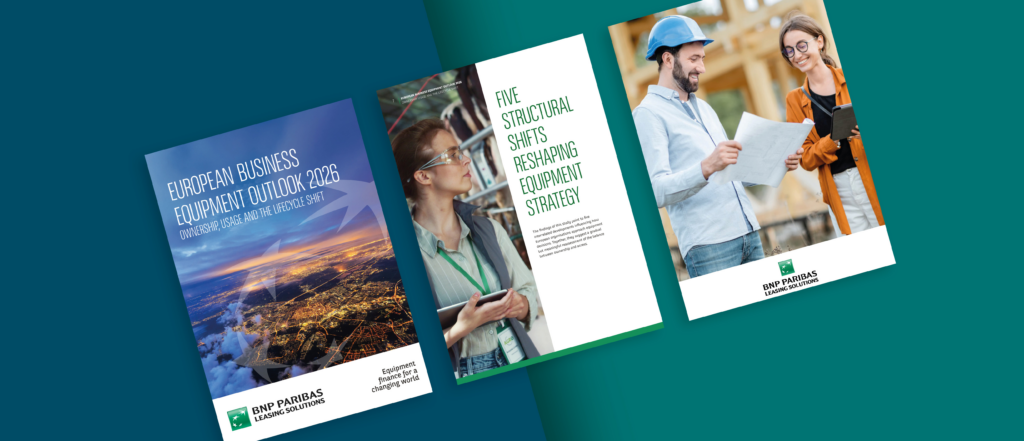
Paris, London 20th May 2026 – BNP Paribas Leasing Solutions, a leading provider of business equipment finance, has released new research showing that European businesses are re-evaluating equipment investment decisions as capital, technology and lifecycle pressures intensify.
The European Business Equipment Outlook 2026, based on research among more than 1,000 C-suite and senior decision-makers across Europe, found that 87% of business leaders have experienced growth constraints because capital remained tied up in owned physical assets.
The findings suggest that equipment decisions are becoming more complex, as organisations weigh the benefits of ownership against capital constraints, technology uncertainty and lifecycle management challenges.
The research spans equipment-intensive sectors including agriculture, construction, transport and logistics, technology, healthcare and renewable energy.
Against a backdrop of rising borrowing costs, persistent inflationary pressures and geopolitical uncertainty, the research shows that long-term capital allocation decisions are becoming increasingly difficult for business leaders. According to the Purchasing Managers’ Index (PMI), eurozone business activity contracted in April as global conflict pushes up fuel and production costs for many European businesses. This is adding further cost pressure to businesses and making long-term investment decisions inherently more complex.
When asked how they would redeploy capital if it were freed from physical assets, respondents identified a range of strategic priorities:
- 32% would prioritise market expansion and digital transformation
- 31% would invest in R&D and innovation
- 33% would invest in sustainability initiatives, green technologies or energy efficiency.
“For many businesses, the issue is no longer whether to invest, but how to invest without unnecessarily tying up capital that could be deployed elsewhere. Capital lock‑up is reducing flexibility for European businesses at a time when they need it most. Leaders want to invest in growth, innovation and sustainability, but too much capital remains locked into assets that can quickly lose value.”
Neil Pein, CEO at BNP Paribas Leasing Solutions
The research also highlights growing pressure from accelerating technology cycles. Business leaders are almost unanimous (95%) in their belief that equipment becomes obsolete faster than it did five years ago while 64% say uncertainty about future technology is delaying capital expenditure decisions. This creates a growing challenge for organisations: commit capital today and risk assets becoming outdated faster than expected, or delay investment and risk slowing innovation and competitiveness.
Alongside financial and technology pressures, the report points to a growing operational challenge around lifecycle management.
Nearly nine in ten organisations (87%) say managing the end-of-life of owned equipment is challenging, while 68% say the ease of refurbishment, reuse, recycling or disposal now influences procurement decisions.
The findings suggest that business leaders are placing greater emphasis not only on acquisition and financing decisions, but also on how equipment is managed across its lifecycle, as regulatory expectations, sustainability scrutiny and operational complexity continue to rise.
“Ownership remains an important and appropriate strategy in many situations. But organisations are increasingly evaluating equipment decisions through a broader lens – considering not only control and long-term use, but also flexibility, adaptability and lifecycle responsibility. The question is becoming less about ownership versus access, and more about choosing the right approach for the asset, the business need and the pace of change.”
Neil Pein, CEO at BNP Paribas Leasing Solutions
More insights can be found in the European Business Equipment Outlook 2026.
– ENDS –
ABOUT BNP PARIBAS LEASING SOLUTIONS
BNP Paribas Leasing Solutions provides capital‑efficient equipment financing solutions across key sectors including agriculture, construction, transportation, materials handling, ICT, healthcare and green technologies. With 70 years of experience, the company supports partners and clients with deep market expertise, asset know‑how and advisory services to drive growth, transformation and the transition to a low‑carbon circular economy. In 2025, BNP Paribas Leasing Solutions advanced €15.5 billion in asset finance and manages a leased asset portfolio of €38.8 billion. Present in 18 countries across Europe and Türkiye, and employing more than 3,000 experts, the company also offers vendor finance solutions in the United States and Canada in partnership with Bank of Montreal, and in China through a joint venture with Jiangsu Financial Leasing. BNP Paribas Leasing Solutions is wholly owned by BNP Paribas and operates within the Group’s Commercial, Personal Banking & Services division.
For more information, visit leasingsolutions.bnpparibas
Contact
• EIB lends BNP Paribas Leasing Solutions €200 million to support SMEs and midcaps operating in the agriculture and bioeconomy sectors.
• At least 30% is dedicated to climate action and environmental sustainability, facilitating the adoption of more resource-efficient and environmentally friendly equipment by European farmers.
• The operation aligns with the EU rural development policy and promotes economic growth and employment.
[Luxembourg / Paris, 13 May 2026] – The European Investment Bank (EIB) has signed a €200 million financing agreement with BNP Paribas Leasing Solutions to support small and medium-sized enterprises (SMEs) and mid-cap companies operating in the agriculture and bioeconomy sectors across Europe.
The financing is part of the EIB’s broader €3 billion pan-European agricultural programme, launched in 2024 to support sustainable investment across the sector . The programme places a particular emphasis on improving access to finance for young, new and female farmers, who often face structural barriers in securing funding.
The financing will be rolled out across several EU Member States, with initial allocations expected in Italy, Germany, Belgium, the Netherlands and Spain.
At least 30% of the financing will be dedicated to climate action and environmental sustainability, supporting investments such as energy-efficient agricultural equipment like tractors and combine harvesters, renewable energy solutions, and technologies contributing to climate change mitigation and adaptation.
The programme will also support the modernisation and productivity of the agricultural sector, particularly through investments in assets with long economic lifetimes that are often difficult to finance through traditional banking channels.
By leveraging BNP Paribas Leasing Solutions’ pan-European platform, the initiative is expected to improve access to long-term financing, reduce financing costs, extend maturities and mobilise additional private investment. A minimum of 70% of the financing will be allocated to SMEs, with midcaps representing up to 30%.
“This operation will help European farmers and agri‑businesses invest in modern, more sustainable equipment, strengthen their resilience and better manage climate and market pressures. By addressing persistent market gaps and working with trusted partners such as BNP Paribas Leasing Solutions, we are making long‑term finance more accessible, accelerating the transition towards a more resource‑efficient and competitive agricultural sector.”
Gelsomina Vigliotti, EIB Vice-President
This agreement reflects our commitment to supporting the transformation of European agriculture by making financing more accessible, more flexible and more aligned with the challenges our clients face. By combining the strength of the EIB with our pan-European leasing platform, we are helping farmers and agri-businesses invest in more efficient, sustainable equipment while preserving their capacity to grow.

This initiative contributes directly to key European policy objectives, including the EU Common Agricultural Policy (CAP) and the EU Vision for Agriculture and Food, while aligning with the EIB Group’s 2024–2027 Strategic Roadmap, where agriculture and bioeconomy are identified as core priorities.
It also addresses persistent market failures in rural financing, particularly the limited availability of long-term funding for agricultural businesses.
In 2025, the EIB Group provided €6.9 billion in financing to the agriculture and bioeconomy sector, with approximately 60% channelled to SMEs via partner financial institutions.
Through this collaboration, the EIB and BNP Paribas Leasing Solutions aim to accelerate the transition towards a more resilient, sustainable and competitive European agricultural sector, ensuring that financing reaches businesses where it is most needed.
[ENDS]
ABOUT EIB Group
The European Investment Bank (EIB) Group is the financing arm of the European Union, owned by the 27 Member States, and one of the largest multilateral development banks in the world. In 2025, the EIB Group signed €100 billion in new financing and advisory services for over 870 high-impact projects under eight core priorities that support EU policy objectives: climate action and the environment, digitalisation and technological innovation, security and defence, territorial cohesion, agriculture and the bioeconomy, social infrastructure, strong global partnerships and the savings and investments union. Beyond long-term loans for large infrastructure, the EIB Group crowds in private investment for high-risk innovative projects and businesses, with a growing role in Europe’s markets for venture debt, venture capital, guarantees and securitisations.
Photos of the EIB Group’s representatives and headquarters, logo files and video B-roll for media use are available here.
ABOUT BNP PARIBAS LEASING SOLUTIONS
BNP Paribas Leasing Solutions offers capital-efficient business equipment financing solutions in key sectors including agriculture, construction, transportation, materials handling, ICT, healthcare, and green tech.
Drawing on its 70-year history, its partners and clients rely on its market expertise, asset know-how, and advisory services to propel their growth, transformation, and transition to a low-carbon circular economy. In 2025, BNP Paribas Leasing Solutions advanced €15.5 billion in asset finance and presently manages a €38.8 billion leased asset portfolio.
Present in 18 countries across Europe and Türkiye, and employing over 3 000 experts, BNP Paribas Leasing Solutions also offers vendor finance solutions in the USA and Canada in partnership with Bank of Montreal, and in China through a joint venture with Jiangsu Financial Leasing.
BNP Paribas Leasing Solutions is fully owned by BNP Paribas and is positioned within the Group’s Commercial, Personal Banking & Services division.
BNP Paribas Leasing Solutions plays a direct role in supporting the real economy – working alongside businesses that feed, build, move, connect and care for people every day. Our mission is to be a long‑term partner to our clients and partners, supporting their activity through access to essential business assets.
This video explains how we work with businesses across sectors, combining expertise, partnership and a deep understanding of equipment to support growth, resilience and sustainable progress. It reflects our commitment to standing alongside the real economy, today and over the long term.
Watch the video to discover our mission in action.
Join us in unlocking the circular economy
At BNP Paribas Leasing Solutions, we’re not just financing equipment – we’re shaping a more sustainable future. Our commitment to unlocking the circular economy is at the heart of everything we do, from our innovative leasing solutions to our partnerships with forward-thinking businesses.
We invite you to join us on this journey. Together, we can unlock the potential of the circular economy and sustain the world we share.
Access to equipment plays a critical role in how economies develop, industries transform and societies prosper. Across sectors that feed, build, move, connect and care for people, the ability to use equipment efficiently and responsibly shapes both economic performance and environmental impact.
This video captures the purpose that guides BNP Paribas Leasing Solutions: enabling access to equipment while supporting a shift from traditional ownership models towards usage‑based solutions. By staying engaged throughout an asset’s lifecycle, we help optimise its use, extend its value and reduce waste – contributing to a more circular and lower‑carbon economy.
Our purpose reflects the impact we seek to create alongside our partners and clients every day: supporting growth, enabling transformation and helping businesses transition to more sustainable models.
Watch the video to discover what drives us.
Alternatively click to view in English or French.
Join us in unlocking the circular economy
At BNP Paribas Leasing Solutions, we’re not just financing equipment – we’re shaping a more sustainable future. Our commitment to unlocking the circular economy is at the heart of everything we do, from our innovative leasing solutions to our partnerships with forward-thinking businesses.
We invite you to join us on this journey. Together, we can unlock the potential of the circular economy and sustain the world we share.
A recent briefing from the European Environment Agency reviewed evidence on how circular economy strategies can contribute to reducing greenhouse gas emissions. One of its most useful contributions is not a headline number, but a framework: impact sits across before use, during use and after use.
For business leaders, this is less about sustainability rhetoric and more about how assets create value over time. Circularity is not just about recycling. It is about how products are designed, how intensively they are used, and what happens to them once their first use cycle ends. Increasingly, these stages are commercially connected.
Before Use: Design Shapes Cost and Performance
A significant share of a product’s cost base – and environmental footprint – is determined at the design and production stage. Decisions around durability, repairability, modularity and material efficiency directly affect uptime, maintenance costs and replacement frequency. Manufacturers are already responding to supply chain volatility, material constraints and regulatory pressure. Designing products that last longer and can be upgraded rather than replaced is becoming a competitiveness issue.
Business models influence this. When value is delivered over time rather than captured only at the point of sale, durability and serviceability become commercially relevant.
During Use: Utilisation Is an Efficiency Question
The “during use” phase is often overlooked in executive discussions, yet it is where significant operational inefficiency can sit. Across sectors, assets are frequently underutilised, replaced earlier than necessary, maintained inconsistently and disconnected from structured lifecycle planning
From a management perspective, this represents idle capital and avoidable cost. Usage-based approaches – including rental, product-as-a-service and performance contracts – shift the focus from ownership to outcomes. Instead of asking “Who owns the asset?”, the question becomes “How efficiently is it delivering value?”
Higher utilisation rates can mean fewer assets are required to deliver the same business output. Extended lifetimes reduce replacement cycles and disruption. Structured maintenance improves reliability and productivity.
Research reviewed by the European Environment Agency suggests that these shifts can contribute to lower emissions by reducing demand for new production. But even without the climate lens, the commercial logic stands: better utilisation improves capital efficiency and operational resilience. Any emissions benefit is a by-product of improved asset productivity – not a standalone claim.
After Use: Recovery Depends on Earlier Decisions
Recycling and recovery remain important, but they rarely compensate for inefficient use upstream. End-of-use outcomes can depend on multiple factors such as:
- Whether condition and usage data were tracked
- Whether the product was designed for refurbishment or disassembly
- Whether secondary applications exist
If assets are deployed within structured frameworks where maintenance and condition are monitored, then refurbishment and redeployment become more viable. For the user, this translates into smoother transitions, less operational disruption and more predictable asset planning. Again, the commercial driver is continuity and efficiency. Environmental gains follow when fewer new products need to be manufactured to replace prematurely discarded ones.
Connecting the Phases: Why Business Model Matters
The EEA’s lifecycle framing highlights something practical: the three phases reinforce each other:
- Design affects longevity.
- Utilisation affects replacement demand.
- Traceability affects redeployment options.
Usage-based models operate most directly in the “during use” phase, but they influence the others. When revenue is linked to performance over time, here is greater incentive to support durable design, maintenance becomes structured rather than reactive and asset planning becomes lifecycle-based rather than transaction-based.
This alignment does not automatically reduce emissions. Outcomes depend on sector characteristics, energy systems and user behaviour. But it does create conditions in which lower material throughput – and therefore lower upstream production emissions – become more likely. For general management, that translates into improved asset productivity, reduced operational downtime and stronger collaboration with suppliers. The climate dimension increasingly sits within these operational choices, rather than outside them.
A Practical Perspective
Circular economy discussions can become abstract. The more relevant question for executives is straightforward: How do we extract more value from the assets already in circulation?
- Extending useful life by two or three years?
- Increasing utilisation across difference customer segments?
- Designing products that can be upgraded instead of replaced?
These are operational decisions with financial consequences. The European Environment Agency’s research suggests that when these shifts occur at scale, they can also contribute to emissions reduction. The degree of impact will vary, and it should be measured rather than assumed.
No single model guarantees outcomes. What matters is whether lifecycle thinking becomes embedded in commercial decision-making. In that sense, the circular economy is less about waste management and more about asset strategy – and for many sectors, that conversation is already moving from sustainability teams into the boardroom.
(This article was published by Motor Transport on 7 April 2026 and is available in English only.)
As fleet electrification accelerates across Europe, the road haulage sector is entering a new phase. In an article published by Motor Transport, Dr Ouafae Cohin, Global Business Development Manager for Green & Tech Market at BNP Paribas Leasing Solutions, highlights a strong signal: the first electric HGV to cross the English Channel, illustrating the potential of long‑distance electric freight. This momentum is part of a broader context of rapid growth in electric vehicle sales, driven by tightening emissions targets, a widening range of available models, and improvements in total cost of ownership.
The article also points to a major challenge: the growing gap between electric vehicle adoption and the pace of charging infrastructure deployment. The specific needs of the haulage sector, pressure on existing networks, high investment costs and emerging financing models are examined, notably through the rise of “charging‑as‑a‑service” solutions. A must‑read to understand why infrastructure, just as much as vehicles, will be decisive in sustaining the electrification of transport.
Read the full article on the Motor Transport website
[Paris, France –14 April 2026]
BNP Paribas Leasing Solutions, a leading provider of business equipment finance, has signed an agreement with Carrier, global leader in intelligent climate and energy solutions, to establish a strategic financing agreement across Europe. The agreement sets the foundation for a multi-country financing partnership to support Carrier’s commercial customers with financing solutions.
Under this agreement, BNP Paribas Leasing Solutions and Carrier will offer finance leases and hire-purchase solutions for commercial HVAC equipment including heat pumps, chillers, boilers and air handling units. The collaboration is designed to enable Carrier’s European affiliates to deliver equipment to end-users with attractive financing options.
As businesses across Europe face rising energy costs, increasing regulatory pressure and the need to accelerate the transition to more energy-efficient and electrified systems, access to flexible financing is becoming a critical enabler of adoption.
The partnership extends across major European markets such as Germany, France, the United Kingdom, Spain, Portugal, Italy, Austria, Belgium, the Netherlands and Poland, with the potential to reach additional EU countries in the future.
A statement from BNP Paribas Leasing Solutions:
“We are proud to partner with Carrier to make high-quality, energy-efficient equipment more accessible across Europe. This agreement demonstrates how innovative financing can support business growth while contributing to sustainability goals,” said Pascale Favre, Managing Director for BNP Paribas Leasing Solutions’ technology leasing division.
A statement from Carrier:
“This agreement enables Carrier to deploy advanced HVAC systems on a lease basis to our customers, accelerating adoption of more energy-efficient technologies across Europe,” said Marc Eckerhall, Executive Director Services & Aftermarket, Climate Solutions Europe, Carrier.
– END –
About BNP Paribas Leasing Solutions
BNP Paribas Leasing Solutions offers capital-efficient business equipment financing solutions in key sectors including agriculture, construction, transportation, materials handling, ICT, healthcare, and green tech. Drawing on its 70-year history, its partners and clients rely on its market expertise, asset know-how, and advisory services to propel their growth, transformation, and transition to a low-carbon circular economy.
For more information, visit leasingsolutions.bnpparibas.com
About Carrier
Founded by the inventor of modern air conditioning, Carrier is a world leader in high-technology heating, air-conditioning, digital platforms and building automation systems. Carrier provides sustainable solutions, integrating energy-efficient products, controls and service for commercial applications, including data centers, healthcare facilities, schools, retail centers, office spaces and more. Carrier is a part of Carrier Global Corporation, global leader in intelligent climate and energy solutions, committed to creating innovations that bring comfort, safety and sustainability to life. For more information, visit www.carrier.com or follow us on LinkedIn.
Carrier. For the World We Share.
At BNP Paribas Leasing Solutions, our purpose is clear: to unlock the circular economy to sustain the world we share.
This is not a sustainability statement added alongside our business strategy. It reflects how we believe equipment markets are evolving – and where long-term value will be created.
Across Europe and beyond, expectations are changing. Customers want flexibility. Regulators expect longer product lifecycles. Secondary markets are becoming more structured. Equipment is expected to deliver performance over time – not just at the point of sale.
For manufacturers and suppliers, this raises a strategic question:
How do we design commercial models that keep assets productive for longer – while protecting margin and strengthening customer relationships?
Traditional equipment sales are built around ownership transfer.But ownership is not always what customers prioritise. Increasingly, they want:
- Access instead of capital commitment
- Predictable monthly costs
- Guaranteed uptime and service
- Flexibility to upgrade or scale
Usage-based and rental models respond directly to these needs. They also allow OEMs and distributors to:
- Stay connected to assets beyond first delivery
- Organise refurbishment and second-life channels more effectively
- Retain greater visibility over residual value
- Build recurring revenue streams
This is not theory. It is commercial logic aligned with market reality.
Leasing as a Strategic Enabler
Leasing is often seen as a financing solution that supports sales. But in a circular context, it can do more. When structured deliberately, leasing becomes a framework for:
- Usage and rental programmes
- Take-back and redeployment
- Lifecycle extension
- Professional remarketing
It creates continuity between first use and subsequent use. That continuity is what makes circularity operational – not aspirational.
Working with OEMs to Make It Real
Unlocking the circular economy requires alignment across the equipment ecosystem.
Our role is to work alongside OEMs, distributors and dealer networks to develop models that are:
- Commercially viable
- Operationally manageable
- Scalable across markets
This includes supporting:
- Usage-based leasing and rental offers
- Refurbishment strategies
- Structured second-life deployment
- Data visibility across the asset lifecycle
Through partnerships with manufacturers and equipment suppliers, as well as our collaboration with BNP Paribas 3 Step IT, we are contributing to models that integrate financing, asset management and refurbishment capabilities.
These initiatives are not presented as complete solutions. They are disciplined steps toward more controlled and sustainable equipment lifecycles.
A Leadership Opportunity
The transition toward circular models will not happen uniformly across sectors. Some manufacturers will move cautiously. Others will test hybrid approaches. A few will shape the standards that others follow. Those who take early steps to integrate usage, lifecycle management and structured redeployment into their commercial strategy can:
- Differentiate their offer
- Strengthen long-term customer value
- Improve control over used-equipment channels
- Position themselves credibly in a market that increasingly values resource efficiency
The circular economy is not achieved through declarations. It is built through operating decisions.
Purpose in Action
Our commitment to unlock the circular economy means focusing on what we can influence:
- Designing financing solutions that encourage usage.
- Supporting partners ready to extend asset lifecycles.
- Building frameworks that keep equipment in productive use for longer.
We do not claim that the circular economy is already realised. But we believe it will be shaped by practical collaboration between manufacturers, suppliers and financing partners who are willing to evolve. And we are committed to being one of those partners.
Agriculture and construction are foundational to the real economy. They produce, build and sustain the infrastructure on which communities depend. Their performance is shaped not only by engineering innovation, but by how confidently businesses can invest in that innovation.
Today, the technology exists to make these sectors more efficient and less resource intensive. Smarter machinery, alternative fuels and precision systems are increasingly available. The question is not whether progress is possible – it is how to accelerate adoption in a way that works commercially for customers and strategically for partners.
That is the role of the Joint Venture (JV) between CNH Capital and BNP Paribas Leasing Solutions.
By structuring usage-based financing aligned to operational realities, the JV helps ensure that innovation reaches the field – not just the brochure.
Supporting investment that makes sense
In asset-heavy sectors, equipment decisions are long-term decisions. Operators balance productivity, cost, cash flow and risk. Even when newer models offer meaningful improvements in efficiency or emissions performance, replacement can be delayed if the investment feels disproportionate.
Usage-based models offer a different path.
By aligning payments more closely with how equipment is used, they reduce the burden of large upfront commitments and give operators flexibility to renew fleets at the right moment. Investment becomes progressive rather than disruptive.
For manufacturers and distributors, this creates a more consistent renewal dynamic. Innovation adoption becomes smoother. Relationships extend beyond a single transaction and into lifecycle support.
This is not about shifting ownership for its own sake. It is about structuring access in a way that strengthens long-term performance.
Building healthier equipment ecosystems
Circular progress depends on assets moving productively through more than one life.
The JV integrates lifecycle thinking into financing design. When equipment is renewed under usage-based structures, it does not simply disappear from view. It is redeployed, remarketed, reused – in a managed way.
This creates tangible benefits across the ecosystem:
- Customers gain access to the latest technology without unnecessary delay
- Secondary markets are supported with well-maintained assets
- Partners retain visibility across the lifecycle
- Equipment continues delivering value beyond first use
Rather than stretching ownership to its limits, the focus shifts to maintaining performance and circulation.
Enabling broader operational solutions
Progress in these sectors is not limited to machinery alone.
Through the JV, financing can also support system-level innovations. For example, methane capture and utilisation technologies developed by companies such as Bennamann enable agricultural operators to convert methane emissions into usable fuel. This reduces waste while reinforcing on-site energy resilience.
Such solutions require practical financial structuring to make implementation viable. Usage-based approaches allow cost to align with operational benefit, supporting adoption without creating excessive financial strain.
This is where financing supports operational transformation – not by imposing change, but by enabling it.
Partnership as a long-term enabler
The strength of the JV lies in combining sector expertise with structured financing capability.
CNH Capital brings deep understanding of equipment performance and distribution networks.
BNP Paribas Leasing Solutions contributes funding capacity, structuring experience and multi-market reach. Together, this creates a coordinated model where financing is embedded within industrial strategy.
For partners, it provides a framework that supports innovation rollout and strengthens customer relationships. For customers, it offers access models aligned with how they operate. For the wider economy, it sustains investment in sectors that are essential to growth and employment.
Progress designed to last
Circular progress does not happen through isolated initiatives. It emerges when commercial models encourage better use of assets over time. When financing is structured around usage and lifecycle:
- Equipment is renewed at a pace that reflects operational needs
- Assets remain productive across multiple lives
- More efficient technologies are adopted earlier
In this way, circular progress becomes a natural outcome of sound economic design.
By supporting investment in essential equipment, – and structuring usage around real operational realities – the JV supports the strength of the real economy today, while enabling more efficient and sustainable asset use over the long term.